Three roles, three experiences, one purpose
Lee esta historia en español
As can be seen across the globe, the climate crisis is no longer a distant threat, it is a lived reality. In Latin America, we feel this vulnerability deeply, as environmental challenges transform into social conflicts that affect our most vulnerable communities. Whether it is the water crisis, record-breaking temperatures, or the forest fires that have scarred our continent, these are not just headlines—they are the backdrop of our lives.
Despite this socio-environmental urgency, we have yet to fully lean into one of our most powerful tools: climate education and leadership. To date, implementation efforts in the region have not been sufficient. Although many countries have committed to it 'on paper' through laws or curricular policies, these often remain hollow without a holistic and systemic approach.
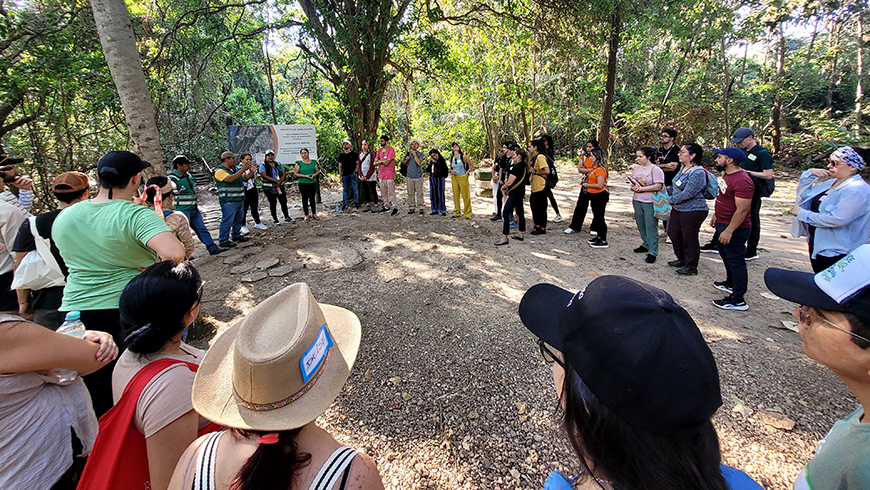
There is still much work ahead, but we find hope in the way people and organizations are stepping in. We are part of a growing ecosystem of agencies, schools, and NGOs—like Teach For All and its Climate Education and Leadership community—working to turn the tide. In September 2025, we gathered in Santa Cruz, Bolivia, for the Climate Education Action Summit to move beyond theory and into action. This blog is the story of that encounter, told through the eyes of three people from our network: Victoria Rivera, a participant (fellow) from Enseña Chile; Lisby Sandoval, an alumna from Enseña por Panamá; and Gabriel Sandoval, a former staff member from Enseña Perú. Together, their perspectives offer a window into how we are building a movement for the planet.
Victoria Rivera, Enseña Chile participant
As a participant in the Enseña Chile program, the Climate Education Action Summit was my first opportunity to step outside my local context and meet members of the global Teach For All network face-to-face. I've always been very interested in environmental issues, especially in education, and it was fascinating to be able to connect, share and learn with people who are on the same wavelength—it has been one of the best experiences I've had as a participant.
At the school where I worked, I often felt alone in this passion. It was difficult to make the importance of climate education and leadership visible to my peers, and I realized that my school community lacked the will to address it—partly because no one felt prepared to discuss the topic. There is a massive need for a paradigm shift. The Summit offered an opportunity to learn how to overcome these barriers.
By connecting with others at the Summit, I realized that despite our different geographies across Latin America, our socio-environmental conflicts are remarkably similar. We share the same struggles, which also means we share a wealth of experiences, ideas, and opportunities. Learning from other participants, alumni, and staff members truly reignited my fire to engage my students. Back in Chile, my students and I researched and learned more about nature and how to restore and protect it—from visiting the Osorno Volcano to reflect on our natural wonders, to restoring the Mirasol Wetland right in our own neighborhood. We learned about food sovereignty by planting and managing a greenhouse and connected with our ancestral wisdom through ancient medicinal plants. I dare say that I helped foster agents of change who, I am sure, will continue learning and innovating to solve these challenges in their communities. Seeing children as young as eight years old taking action (and later hearing their parents' gratitude) filled me up and reaffirmed that engaging students in climate education and leadership is not just important, but essential.
This experience, combined with the global perspective I gained at the Summit, has deeply shaped the vision I have for my future. Now that I have completed my two years as a participant with Enseña Chile, I know exactly where I want to venture next: exploring new paths to scale environmental education and climate leadership across the region.
Lisby Sandoval, Enseña por Panamá alumna
When I arrived at the Summit, I did so with a somewhat tired heart. I was coming from intense months of work, trying to balance my time between the environmental projects I work on as a consultant and the climate diplomacy spaces in which I usually participate. In November 2024, I was at COP29 as part of Panama's delegation, contributing to the defense of positions and facing the frustration of not achieving the expected result that our bloc had proposed.And in August 2025, just the month before the Summit, I had returned from another meeting—another scenario where another round for the future Global Treaty on Plastics took place. There, we also failed to reach a consensus to even raise a draft that would guarantee less plastic pollution and better health for the world. Watching the same blockages repeat themselves in the multilateral agreements we desperately need is simply exhausting. It's hard not to hang your head when negotiations, time and again, stall right where they should advance the most.
I arrived at the Summit with that mix of disappointment, fatigue, and doubt that sometimes accumulates when you work on the more political and technical fronts of climate action. But the meeting welcomed me with something I had forgotten how much I needed: community. There were alumni, staff, participants, and allies from throughout the Teach For All network in Latin America. And there was a different energy—more human, closer, and more honest. It was an energy that doesn't come from a document negotiated line by line, but from real people who are transforming their territories through education, community organizing, and local leadership.
And that's where my sense of possibility returned.
I reconnected with Teach For All’s culture and with the deeper reasons why I do what I do—a culture that bets on human potential and on the conviction that change is built from the bottom up, and not the other way around. It is a culture that understands that education is not just a right, but a tool for resilience, collective power, dignity, and the future. I also reconnected with my own story as an alumna of Enseña por Panamá. Being there, surrounded by people who share my values, reminded me that my work—both in projects and in climate diplomacy—is not separate from educational work. Everything is intertwined; everything feeds back into each other.
Hearing alumni and territorial leaders talk about their contexts, their proposals, their daily struggles, and their audacity to face them gave me back my clarity. I saw how solutions are born in their communities that diplomacy is still learning to listen to; I saw how climate action is more powerful when it has roots in people, in knowledge, in memory, and in lived experience. I kept filling myself with ideas, possible collaborations, and concrete ways to connect my work with those who are building changes from schools, neighborhoods, and coasts in my country.
I left with the certainty that my efforts in international political scenarios can only make sense if they remain connected to the community. I also left with the deep conviction that climate education is a bridge between all the areas I work in: conservation, youth leadership, community participation, project design, and global negotiations. It's where everything converges.
Santa Cruz reminded me that, even after failures at the negotiating tables, the work doesn't lose value. What happens is that sometimes we need to return to the spaces where our vocation was born, where we learned to believe in people and in possible change. And that's what the Summit was for me: an opportunity to reconnect, recharge, and look at my community again with broader, more sensitive, and—why not—more strategic eyes.
I took that renewed energy back to Panama, along with the commitment to continue building bridges between what I do at a global level, what I do with communities, what the Teach For All network drives through education, and the spirit of Enseña por Panamá. Because if one thing became clear to me, it's that the future is built from within our communities, but also from the alliances born when we meet with those who believe in the same things we do.
Gabriel Sandoval, Enseña Perú project manager
The Climate Education Action Summit was my first window into the inner workings of Teach For All network partner organizations in Latin America.My main source of inspiration was the chance to exchange ideas with such a diverse group: staff members ranging from those with years of experience in climate education to those just beginning to integrate climate leadership into their organizational strategies; alumni who have launched powerful climate initiatives; and current participants who engage students daily. These diverse voices created an enriching dialogue and a space that was honest and hopeful—pointing out the internal gaps in climate education within each country, while simultaneously filling us with hope through the examples of actors, inside and outside the network, who are doing everything possible to fill those spaces through purposeful climate action.
Many of our discussions focused on how to deeply integrate climate education and leadership into the ‘DNA’ of our organizations. We explored high-level strategic decisions, such as aligning applicant selection with environmental and climate justice interests, building internal training for technical knowledge, and finding better ways to support participant-led climate action projects in schools. Compared to other staff with more experience in this field, I felt like a lightweight. However, my role as a Project Manager keeps me close to the reality of the participants, and being part of these strategic conversations—and actually contributing to them—was deeply inspiring. This motivated me to bring these insights back to the rest of the Enseña Perú team, with the hope that climate education and leadership will take on more importance across all our programs.
I learned that deeply integrating climate leadership into an organization doesn’t happen in a day. This work is still in progress, but thanks to the Summit, we now have the technical knowledge and direct contact with capable leaders who are already making this transformation a reality across the network.
Through Victoria's, Lisby's, and Gabriel's reflections , we can see that climate education and leadership presents many challenges, but more importantly, many opportunities, and that community and collaboration is essential for this work. While there is still much work to be done, which will probably have numerous obstacles and bring frustration, when looking at what others have achieved or the small steps from communities, one realizes what is possible and that in the end, the efforts bear fruit. Although it may feel like something small, these are significant advances. Each participant who integrates climate education into their lessons, each student who realizes their agency to take climate action, the alumni whose career aspirations shift toward long-term climate leadership, and each community taking action, brings us one step closer to achieving our goal—the important thing is not to lose sight of our purpose and to always work as a network.