Dreaming beyond the horizon: Reimagining STEM and leadership for girls in Kenya
I grew up in Machakos County, Kenya looking at dark skies that carried the stars in all their glory. I would sit outside for hours and envision how great it would be to live on the moon. It seemed calm, and I imagined that I would have all the space in the world.
They always say that firstborn daughters are their father’s sons, and I could see this in how my dad would involve me in everything he did—from doing electrical wiring around the house to building structures around the compound. He didn’t seem to mind when I explored by taking apart our radio or opening up our computer's CPU, as I had seen him do over and over again. These early, hands-on experiences deeply shaped the person I am today: an astrophysicist turned STEM teacher who is passionate about gender equity and equality in science and technology.
I studied astronomy and astrophysics at the University of Nairobi for my undergraduate degree. At first, I imagined my future would revolve entirely around scientific research and exploring the universe. But somewhere along the journey, I discovered something unexpected. While I was learning about stars and galaxies, I was becoming equally interested in people and the economic opportunities available to them. I realized that space science wasn't just an academic pursuit, but a powerful gateway to broader STEM literacy; projects like CANSAT Kenya and initiatives like Women in STEM Kenya became my way of using the cosmos to equip girls with the practical tech, coding, and leadership skills they need to thrive in any modern industry .
I began asking a different question: Who gets the chance to dream big enough to reach the stars?
New horizons: What my experiences revealed
Many students, especially girls, are inherently interested in science. However, they often lack the exposure, resources, and encouragement to see STEM as a viable career path. Data synthesized by the Kenya National Bureau of Statistics (KNBS) shows stark gender gaps in technical training, with women making up just 8% of qualified professionals in tech and engineering disciplines. Conversely, the medical field exhibits the narrowest divide, where women represent a strong 44% of qualified health professionals. This creates an uneven landscape where overall university STEM enrollment sits under 30% for women, leaving sectors like agriculture and medicine closer to parity while engineering remains heavily male-dominated.
I could see this even in my undergraduate program at the University of Nairobi, where out of 30 students, there were only five girls. The rapidly evolving global economy demands critical thinking, digital literacy, and adaptive leadership—skills perfectly nurtured by scientific inquiry. Yet, traditional learning environments often emphasize rote memorization over creative problem-solving, leaving students unprepared for the demands of the modern workforce.
As I reflected on these experiences, I became increasingly aware of the transformative role that education plays in shaping life opportunities. Recognizing the urgent need to address educational inequities, I sought a platform where I could make a tangible impact. That search led me to Teach For Kenya, whose mission resonated deeply with my commitment to educational equity and social change. However, it wasn't until I stepped into my placement school in Machakos County that these national statistics transformed into a vivid, daily reality. I immediately observed that the systemic gaps I had studied were playing out in real-time: girls in my classrooms routinely shied away from science activities, crippled by a stark lack of basic practical resources and a deeply ingrained belief that STEM simply wasn't meant for them.
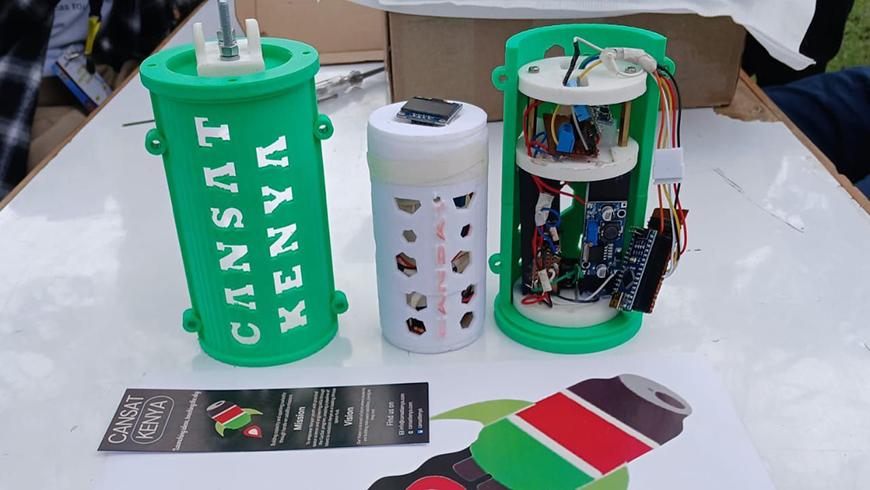
To bridge this gap during my fellowship with Teach For Kenya, I integrated practical applications of space science into my classroom, using hands-on projects like CANSAT Kenya as a launchpad to ignite a broader, lifelong love for STEM among my girls. Through this program, my students designed and simulated small satellite models. This wasn't just about formulas; it was about teaching them how to manage projects, analyze data, and work in cross-functional teams—the exact competencies required in the future world of work.
Reimagining potential: Voices from the classroom and community
The true impact of this approach became clear through the feedback of the students themselves. I looked for women around me, in STEM, who shared the same experiences as me. I shared the vision I had with them, and we created a community—Women In STEM Kenya—and have already impacted over 500 girls across ten schools through this initiative.
One moment from the CANSAT training program has stayed with me. After a day spent designing and building a satellite the size of a soft-drink can, a student named Claire approached me with a question: "Teacher, can I also go to the moon one day?"
What struck me was not the question itself, but what it revealed. Before the training, space exploration seemed distant and disconnected from the realities of many students' lives. Yet by building a miniature satellite, learning about aerospace engineering, and interacting with STEM professionals, Claire began to see herself as someone who could participate in shaping the future rather than simply observing it.
That moment reinforced a lesson I have encountered repeatedly as an educator: the greatest barrier facing many students is not a lack of talent, but a lack of exposure. Too often, young people grow up without access to the experiences, role models, and opportunities that help them imagine possibilities beyond their immediate environment. When students are exposed to new ideas and meet people who have pursued ambitious paths, their aspirations expand. They begin to ask different questions—not whether they are capable, but how far they can go.
Looking beyond the horizon: What I have learned
Developing and implementing both projects taught me two fundamental truths:
- The core challenge is exposure, not potential. Students do not just need academic knowledge; they need environments to experiment, fail, and build confidence. I saw this firsthand when girls who initially called mathematics "too difficult" began leading project teams after experiencing small, collaborative successes.
- Sustainable change requires collective leadership. Real impact occurs when teachers, parents, and school administrators work together. For example, our CANSAT training succeeded because school leaders carved out dedicated workshop space, and parents actively reinforced the value of these new technical tracks at home.
Mapping the next orbit: My leadership action
Building on the foundation of my Teach For Kenya fellowship, I am shifting from localized classroom and working to expand my network by:
- Leveraging our insights from impacting 500 girls, I am currently leading Women In STEM Kenya to expand our mentorship and satellite simulation curriculum into five additional rural schools by the end of this year.
- Securing Technical Resources: To solve the infrastructure gaps I witnessed in Machakos County, I am establishing partnerships with local aviation and technology hubs to secure donated hardware and digital tools for our upcoming bootcamps.
- Building Pathways & Scaling Hands-On STEM for Girls & Future Innovators: As a STEM Matron at my current school, I’m leading that shift on the ground. I established and run a STEM Club where students move from theory to practice through hands-on projects in artificial intelligence, robotics, and electronics. We don’t just learn concepts; we build, test, fail, and solve real problems. But I’m not stopping at one club. The next step is scaling. My goal is to grow this model into pathways that reach more learners and connect them to opportunity. I’m actively upskilling in AI and electronics so I can equip students with the tools they’ll need for the future of work. After all, the same coding and electronic principles used to build a basic robot are what power the rovers and satellites mapping out our universe.
Because the future isn’t just about knowing STEM. It’s about using STEM to create, lead, and solve. The most powerful tool we can give students is not an answer—it is the unshakeable belief that they belong in spaces they once thought were beyond their reach. As we look toward an increasingly technological workforce, we must ask ourselves: How are we actively expanding our educational systems so that every young girl knows she belongs not just under the sky, but also among the stars?