In Cambodia, Climate Education and Leadership ignites change within and beyond the classroom
Every school has its problems, and at Hun Sen Khsach Kandal High School, one of the largest and oldest schools in the Kandal Province of Cambodia, plastic pollution was growing into a serious worry. To address the issue, our school principal declared a new rule: “Don’t allow any single student to bring plastic into the school environment”. While the plan sought to help the school manage plastic waste as an issue with wide-ranging impacts, our students did not understand why they needed to avoid plastics or why banning them was important for them, the school, or their families.
As a Teach For Cambodia fellow teaching English and Financial Literacy at the school, I noticed that in an institution with close to 2,000 students, little pieces of plastic can pile up fast. Plastic accumulated faster than anyone could dispose of it, and it was usually managed by burning. While burning reduces the volume of waste, it poses risks to students and educators because it releases harmful pollutants such as dioxins, benzene, and styrene, which are associated with long-term health issues. For more sensitive children and teachers, these effects can be experienced immediately, leading to coughs and breathing problems. Beyond its impact on human health, burning also degrades air quality, contaminates surrounding soil and water, and contributes to greenhouse gas emissions. It was also not lost on me that our students were already experiencing the effects of rising heat levels linked to climate change. All these challenges, I surmised, could be addressed by engaging students in climate education.
Change starts in and out of the classroom
I started by first integrating climate education into my lessons. I looked for opportunities to connect classroom content with real-world environmental challenges that students could relate to. In English lessons, for example, students honed their writing and grammar skills by composing essays, reflections, and creative pieces on topics such as plastic pollution, waste management, and climate change. In Financial Literacy classes, we explored how budgeting decisions and everyday consumption habits could positively influence both personal wellbeing and environmental sustainability. Embedding climate and environmental themes into core subjects made learning more relevant for my students, as they gradually developed a deeper understanding of the issues affecting their community. As students became more engaged with these topics in the classroom, I sought to extend their learning to include hands-on, problem-solving activities where they could develop their agency and leadership skills.
This led me to design our first initiative, the Climate and Sustainability Education project, which aimed to transform learners into changemakers and future leaders. I designed the project with guidance from works created by the Ministries of Education, Youth, and Sport (MoEYS) and Environment (MoE), as well as the Teach For All Climate Education and Leadership global community, and tailored it to the unique needs of the learners and their communities. I wanted this project to be a space where learners could come up with solutions to impacts they were living through.
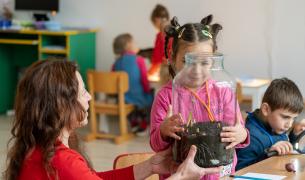
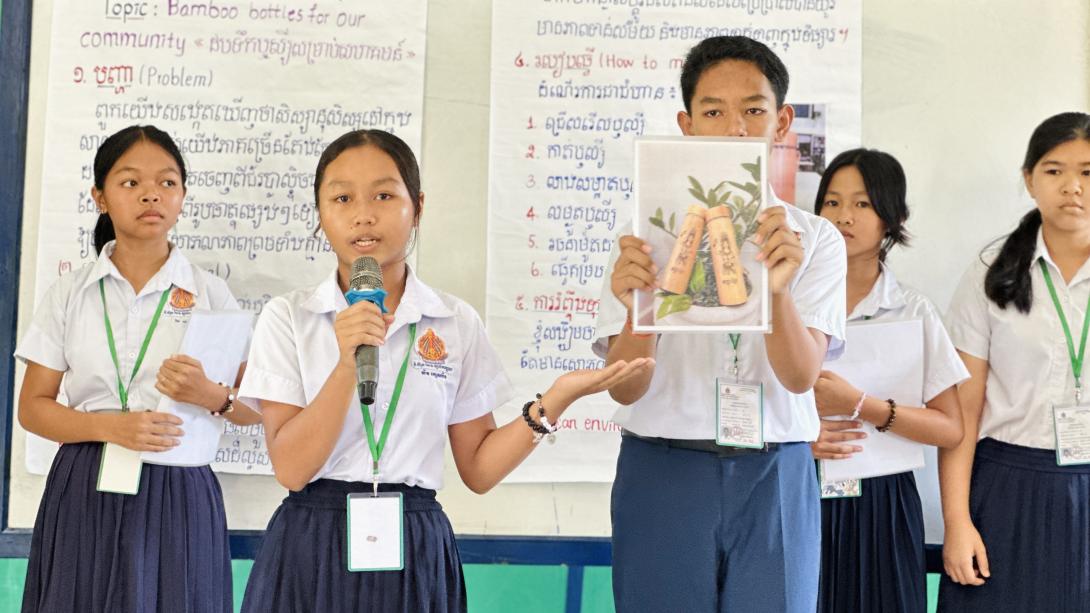
Students worked together to solve plastic pollution in the school and create a clean green environment. While my students lacked financial support to build advanced solution prototypes, they developed innovations powered by their own resources and the willpower to solve challenges competently. To further grow their learning and strengthen their ideas, students attended workshops where they were introduced to foundational concepts in climate change, problem identification, and solution design.
Initially, I was concerned whether the project would have much impact within the school, but it turned out I had nothing to worry about. Our first class of just 50 changemakers grew into ambassadors who spread climate awareness and action both within and beyond the classroom. I saw students grow into their potential as they created small demonstrations and visual drawings that explained how to protect the environment. They became even more engaged through a competitive project format, where different teams presented their ideas and prototypes in a final showcase event. The awards and participation certificates, witnessed by school management, teachers, and fellow students, further motivated participation across the school. By the second year, the showcase had expanded to include over 100 climate champions.
Climate Education’s impact spreads far and wide
I would describe the project as an achievement that was made possible because learners and their communities embraced both its activities and its purpose. For example, students created a Facebook group for the project, which helped to share their work more widely and document their progress over time. Through this platform, learners were also encouraged to engage their parents and community members, creating additional opportunities for addressing environmental challenges together. Beyond developing greater climate awareness, the project also helped students build confidence, strengthen their teamwork skills, and grow into ambassadors for change.
For myself and my fellow educators, the project demonstrated that students care deeply about the environment and have the capacity to influence meaningful change. It also showed that learners are able to take action when they are guided on how, why, and what their ideas and actions can contribute. What we were able to achieve at Hun Sen Khsach Kandal High School stands as both a testament and a challenge to relevant ministries and supporting partners to scale these efforts further. Ultimately, investing in climate education for students—the next generation—is a powerful strategy for developing climate leaders and building a greener, more sustainable future.