Teach For Ukraine: Choosing hope when air raids are part of everyday life
For many people around the world, news about Ukraine has become an endless stream of headlines. For us, it is our everyday reality—one in which our team, Fellows, alumni, teachers, and the children we work with continue to live and work under constant attack.
On the night of July 30, one of the most devastating tragedies struck our community. Russian forces attacked the Kryvyi Rih district of Ukraine’s Dnipropetrovsk region. An Iskander-M ballistic missile struck the home of the Voronov family in the village of Radushne. The family had ten children.
At the time of writing, the deaths of the parents and three of their children—17-year-old Mark, 11-year-old Azariy Ilai, and six-year-old Emilia—had been officially confirmed. Four other children and their one-and-a-half-year-old grandson were still missing and presumed dead.
Among those killed were children who had been students of Teach For Ukraine alumna Tetiana Burynyk who taught mathematics and computer science in the village from 2021 to 2023. Today, she is mourning children she personally knew and taught. She remembers teaching computer science to Mark, Dominika, and Viorika, as well as technology classes to Matvii, who was abroad at the time of the attack.
These are children from our community.
“While I was teaching at the school, Dominika and Viorika were in the seventh and fifth grades respectively,” Tetiana shared.”We first got to know each other during remote learning at the beginning of Russia’s full-scale invasion of Ukraine. I remember them as diligent students who excelled academically and participated actively in lessons, which was actually quite rare during online classes.
I knew Mark a little better. We had six months of in-person classes together and then another year and a half of remote learning. He was always a very kind, caring, and cheerful boy. He often told me about going fishing with his friends.
When Russia’s full-scale invasion began, Mark was in the eighth grade. Even at such a young age, he was deeply engaged with everything that was happening. He talked about how he was helping others, was always the first to share news in our class chat, and perhaps believed in Ukraine’s victory more than anyone else.
Mark supported both the other children and me. He promised that he would protect us, joked a lot, and imagined how he would one day tell his own children about these times. To a great extent, it was thanks to him that I became so close to the students in this class.
Although I had not spoken to Dominika, Viorika, or Mark for a long time, I remember very clearly what bright and kind children they all were. It is difficult for me to comprehend that almost an entire family could be gone in a single moment—that so many children who should have had happy futures are no longer here.
It is difficult to put into words what I feel now. I feel grief and warmth when remembering these children, an enormous void in my heart, and even a certain sense of guilt that, as an adult, I could do nothing to keep this family alive.
I would very much like people to remember this family—to remember the wonderful people we have lost and the future that the Russian war has once again stolen from us.”
Our entire community shares the pain of this loss.
According to the UN Human Rights Monitoring Mission, June recorded the highest total number of civilian casualties in Ukraine since April 2022. At least 293 civilians were killed and 1,990 injured during the month. This trend continued throughout July as Russian attacks on civilians intensified.
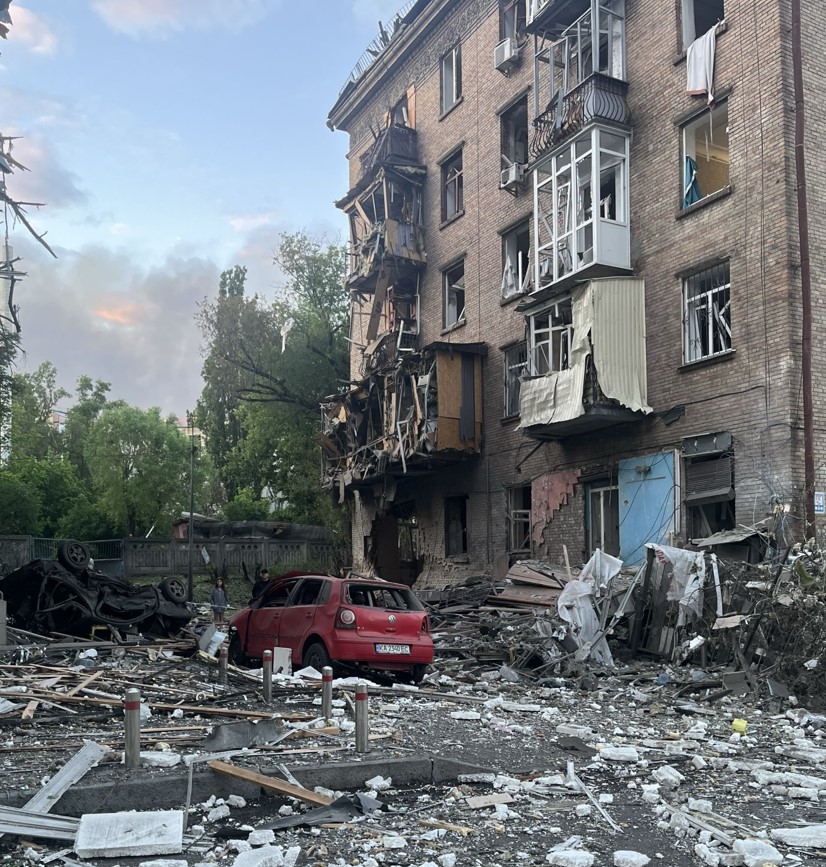
Air raid alerts have become part of everyday life. Almost every night, Ukrainian cities are attacked by Russian drones, while large-scale missile strikes take place every few days. Communities closer to the frontline endure hundreds of attacks involving guided aerial bombs and artillery every day.
Over the past two months, many members of our Teach For Ukraine team have spent several nights each week in bomb shelters or metro stations, only to return to work the following morning. Russian attacks damaged the homes of two members of our communications team.
Like millions of Ukrainians, our colleagues continue working while coping with the loss of their sense of safety, damage to their homes, sleepless nights, and the constant uncertainty that comes with every new night.
Despite all of this, our team and community continue to support teachers, children, and local communities across Ukraine.
We hope these stories provide a window into the reality Ukrainians are living through today and remind us all that behind every educational programme are real people who spend nights in shelters and return to work in the morning, who grieve their students and rebuild their homes, and who, despite constant attacks, continue to choose hope, education, and community, while fighting for their freedom and their future.