STEAM Teachers Supporting Students to Lead and Contribute in Their Communities
Salimot Akande noticed the desks first. Empty ones at the morning bell, followed by students arriving late and others falling asleep over their notebooks. She asked them why. Many had been up since before dawn, carrying water home.
Salimot, a STEAM educator and Teach For Nigeria fellow, could have treated the pattern as a discipline issue. Instead, she brought the problem into her science lessons. Fifty students mapped how their community gets its water and found that seven in ten of their classmates relied on contaminated wells.
The school's Change Maker Club then built three versions of their filter to find out which final layer worked best, comparing serviette paper, cotton wool and foam. When they scaled up the winning design, it failed: the weight of the water tore through the bottom layer, and charcoal dust clouded everything they had collected. The students reinforced it with mesh, while parents and the community in Pejuola provided the barrels and gravel. As Salimot describes it, this kind of education teaches students that they have the power to change things.
Her students were learning about filtration. They were also learning how to investigate a problem affecting their community, work with others, test an idea, respond when it failed, and try again. These are the experiences that develop both knowledge and leadership.
Preparing students to lead on the challenges ahead
The challenges today's students will meet as adults will rarely fit inside a single subject. Water scarcity, environmental degradation, food insecurity, and public health pressures already affect communities around the world, and addressing them will take technical knowledge alongside leadership, including the ability to work with people to solve problems.
This is one of the opportunities of STEAM education. A holistic approach to STEAM teaching and learning develops students' technical knowledge and their leadership together. Students use what they learn to understand problems, explore solutions, and be prepared to contribute to their communities and the wider world.
Across the Teach For All network, STEAM teacher leaders are making this connection in different ways. Some build opportunities for leadership directly into classroom learning. Others connect classroom learning to real-world challenges, giving students the chance to apply their knowledge to problems that matter where they live.
Some teachers build student leadership into STEAM lessons
Inasse Al Assaad, a STEAM educator and Teach For Lebanon alumna, gives students aged ten to thirteen a role as eco-researchers in her project “Waste-Free Kitchen”. Students observe what gets thrown away at lunch, analyze what they find, and build a model kitchen from everyday materials, including a shelf for leftovers and a space for compost. They finish by identifying one change they will make themselves. A familiar environmental issue becomes an opportunity to investigate, make choices, and take responsibility.
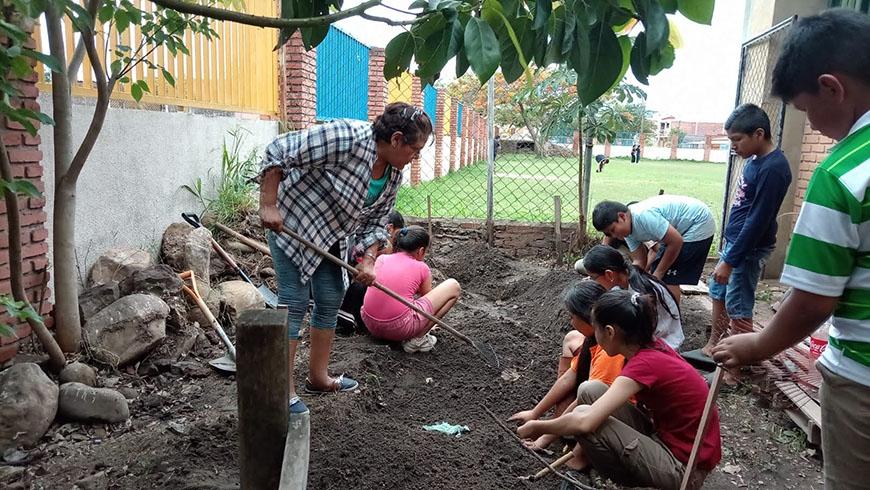
In Bolivia, nine- to eleven-year-olds take turns as soil scientists, data recorders, and agronomists in their school garden. Their teacher, Joaquín Chila Frontanilla, a STEAM educator and Enseña por Bolivia alumnus, calls the four-by-one-meter plot a “living laboratory.” Students built the border from bricks, wood, and stones they gathered, and learned from families and local farmers about growing food. Each child writes a promise about caring for the garden.
In both classrooms, students practice leadership through the learning itself. They take responsibility, work with others, make decisions, and think about how their actions affect the world around them.
Others connect classroom learning to real-world challenges
For other teachers, the connection begins with a problem beyond the school gate. In some of Kathmandu's oldest neighborhoods, fire engines cannot reach a burning house because the lanes are too narrow, and people have died as a result. Ujjwal Koirala, a Teach For Nepal alumnus who teaches STEAM at Lympiya National School, brought that problem to his robotics club, and thirty students from grades eight through ten set out to build a machine small enough to get in.
Before settling on a design, they carried cardboard prototypes into the lanes and asked the people who live there what would work. Residents and neighborhood elders told them the wheels would get stuck in the deep cracks of the ancient stone pavement, so the students switched to a tracked drive. Then the batteries failed, draining in minutes and taking the video feed with them, and the grade nine students spent a week on the power system before the robot would run for thirty minutes. When they were ready, they presented all of it to parents, school leaders, neighbors, and people from industry.
In Zimbabwe's Mutoko District, Didymus Mudziwepasi, a STEAM educator and Teach For Zimbabwe fellow, works with students at Mudzonga Secondary School on community tree planting. Then his students noticed something discouraging — the plastic bags used to raise seedlings break down into microplastics that destroy the soil organisms young trees depend on, and tree survival was failing as a result. Their own restoration work was undoing itself.
So Didymus’ students asked where in the cycle they could intervene, and then a sharper question: what if the solution is already hidden within the problem? They searched local agricultural waste and found their answer in the bulk packaging the tobacco industry discards once bales are opened. Buried in soil, it breaks down completely. They sewed it by hand into seedling bags that disappear into the ground within two weeks, so a seedling can be planted without anyone pulling it from a bag and disturbing its roots. Then they took the prototype to agricultural extension officers and community leaders and made their case.
Giving students opportunities to lead
Across these classrooms, students did real things. They asked residents and elders what a robot would meet in a narrow lane. They rebuilt a filter that had collapsed under its own weight. They stood in front of agricultural extension officers and made the case for a material everyone else was throwing away.
Those experiences prepare students for a future in which the challenges they meet will rarely have simple answers. These young people came to see themselves as people who can use knowledge, work with others and contribute to solving problems in their communities and beyond.
None of this happens by accident. Teachers make deliberate choices about what students learn, which questions they investigate, whose knowledge they draw on, and how much responsibility students take for the work. When teachers connect STEAM learning with the realities their students experience, they create opportunities for students to develop both their knowledge and their leadership.
On STEAM Day, these stories show what STEAM teachers make possible when learning gives students both knowledge and the opportunity to lead.
One question to take with you: what does your community already know that young people are not yet learning from?