Creating an Island of Stability: How Teach For Ukraine Fellows support learning amidst blackouts and bitter cold
At a challenging moment for many communities and countries across the globe, several Teach For All network partners are operating in extreme, often protracted crisis contexts, where their fellows, students, staff, and the communities where they live and work face danger, scarcity, and other hardships on an ongoing basis. Below, Okasana Ziobro of Teach For Ukraine describes how fellows and their students continue to teach and learn—and find moments of joy—despite the blackouts and bitter cold resulting from recent attacks on critical infrastructure in multiple cities.
This winter, the school curriculum in many Ukrainian schools is being shaped not by educational specialists, but by the mechanical condition of generators and the frequency of air strikes. Since the beginning of January alone, 1,646 air raid sirens have sounded across Ukraine. The attacks by the Russian government are not isolated incidents but a constant background to everyday life, targeting cities, energy facilities, civilians, and civilian infrastructure across the country.
January’s deep freeze, with temperatures plunging to -22°C for several weeks, coincided with massive strikes on critical infrastructure. This led to prolonged blackouts—periods lasting from several days to weeks during which entire regions lost electricity, heating, water, and connectivity at the same time.
The heating situation is particularly dire. During extreme frosts, the liquid in heating systems freezes rapidly, leading to large-scale infrastructure failures: pipes burst, buildings flood, and schools and homes become uninhabitable.
Under these conditions, a school often becomes the only place where children can warm up, charge their devices, or have a hot cup of tea thanks to a generator. Yet, the question remains: is meaningful learning possible under such circumstances—and how can children study when they return to freezing, dark homes? The same challenges are faced daily by teachers, who must manage their own households before heading to school to create a learning environment for their students.
While Teach For Ukraine Fellows have been shaped by a leadership development program that prepares them to take responsibility and act in under-resourced communities, even under extreme and unstable conditions, the current situation poses unprecedented challenges. In the following reflections, fellows in impacted regions describe how they and their students are prioritizing learning and wellbeing inside and outside of the classroom:
Kyiv Region
 In Stari Petrivtsi village, the cold reshapes even basic classroom practice for Teach For Ukraine Fellow Zoia Komisar, a teacher of Ukrainian language and literature. Students often ask for fewer written assignments because their hands are freezing. Lessons shift to verbal exercises and physical movement to help children stay warm and focused. The format of the lesson is often decided on the fly, depending on the conditions and the children's wellbeing. Like many teachers, Zoia strives to support her students despite grueling personal living conditions:
"We recently had a blackout that lasted nearly three days: the temperature in my house dropped to +9°C, and water supplies were exhausted. The lock on my front door froze so solid it became unusable—I’ve been living with my door wide open for a week now."
In Blystavytsia village, where Teach For Ukraine Fellow Olena Havryliuk, teaches mathematics, frost severely disrupts even basic school logistics. School buses often fail to start, forcing some children to commute on their own or miss classes entirely. Lessons are shortened to 30 minutes, requiring teachers to condense the curriculum. To keep students engaged, Olena improvises:
"I do dance warm-ups with the students and turn the walk to school into a small adventure, finding playful ways to keep moving and stay warm. I always carry a thermos of hot tea. What keeps me going is seeing the children's desire to learn—when they ask for extra sessions to catch up on what we’ve missed."
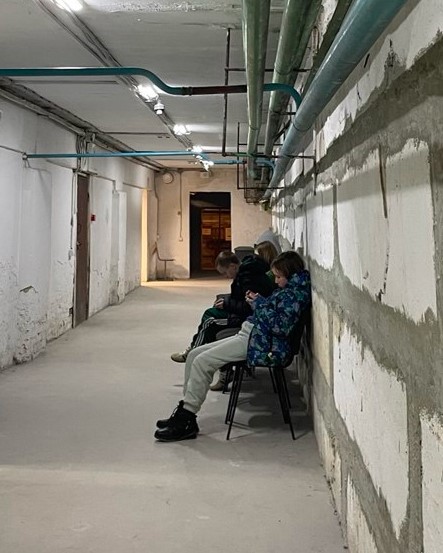
Despite parents’ requests to switch to remote learning, online education has often proven impossible in the current conditions due to asynchronous and prolonged power outages affecting both teachers and students. When an air raid siren sounds, online classes stop entirely, whereas in-person classes have a chance to continue in a shelter. However, conditions there are often harsher than in the classroom: temperatures are lower, students cannot leave due to the threat of strikes, and stays in the shelter can last four to five hours.
Poltava Region
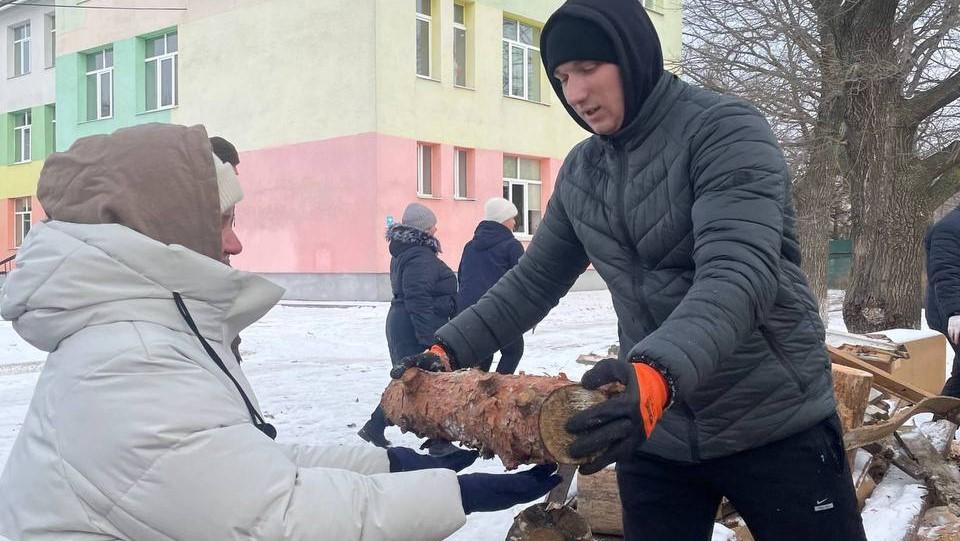
In one community in the Poltava region, the school is heated half by gas and half by wood. As a result, the entire teaching staff participates in maintaining the school’s operation; gathering firewood has become a collective responsibility because the workload is too heavy for one person. In Omel'nyk village, Teach For Ukraine Fellow Liudmyla Poberezhna, a teacher of Ukrainian language and literature, and her colleagues find enduring the prolonged instability of war is made easier by focusing on what continues to inspire them most: the children.
"The children are incredible. They cope better than adults, and I find myself learning from them. They show interest, initiative, and a hunger to learn. They truly value the 'island of stability' that the school provides right now. I try to match their energy and hold on. We play volleyball, sometimes by flashlight—it’s a huge support."
However, this resilience isn't universal. Karyna Turova, an English teacher in Horishni Plavni, observes how prolonged stress affects students in different ways:
"Some children become more withdrawn, while others become very loud because they can’t otherwise cope with the tension. I also see them trying to joke in the shelter to manage their anxiety, warming up with tea and sharing cookies."
Odesa Region
December 2025 was marked by the longest blackout for Odesa since the start of the full-scale war. After an attack on the night of December 13, the region was left without electricity for several days, as many as 10 days in some districts. The consequences are ongoing: power outages continue into January, and repeated attacks plunge communities back into darkness.
In Balta, cold classrooms directly undermine Teach For Ukraine Fellow Andriy Hurin’s students' ability to concentrate:
"Children aren't motivated to come to a school where it’s +5°C. It’s hard for them to focus or even physically sit through a lesson. It’s also impossible to use presentations or interactive exercises without power. But at least it’s beautiful outside. The students play on makeshift ice rinks, and we join them. That is our solace."
Despite the cold, darkness, and constant danger, learning continues. These months are not an exception but part of a reality Ukrainian schools have been living in for years. Teach For Ukraine Fellows step into this reality as leaders—taking responsibility for learning, care, and continuity in their classrooms and being engaged members of their communities. Alongside them are extraordinary children, whose resilience, curiosity, and capacity to adapt make education possible even under conditions that seem incompatible with learning.