From rubble to system change: A STEAM journey rooted in community and leadership
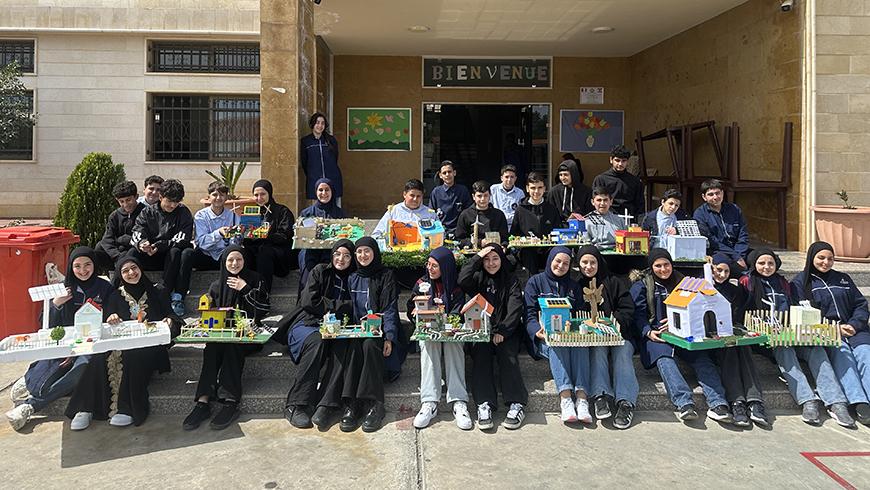
I never planned to work on sustainable housing, coordinate a STEAM Lab, or represent Arab youth in SDG4 spaces. This journey didn’t begin with a grand vision or national initiative. It started in a public-school in South Lebanon with one honest question: How can learning help students rebuild their lives, not just memorize content?
Tibnin, South Lebanon is deeply affected by conflict and instability. I was once a student in this same community, and today I am a Teach For Lebanon fellow here. So when my students spoke to me about loss and displacement, it wasn’t distant, it was something we were navigating together. After months of displacement and damaged homes, their frustration surfaced when I asked them: "If we could solve one problem in our community, what would it be?" and their answer was immediate: "Our homes were destroyed."
The pain in the room was palpable. But so was something else—a spark of agency I hadn't seen in months. "Then let's not just talk about it," I said. "Let's solve it."
That day, we abandoned the curriculum and began designing sustainable homes using low-cost or reclaimed materials. Students dove into researching insulation, ventilation, solar energy, and climate adaptation. They built cardboard prototypes, sketched rough designs, and redesigned constantly. Every failure became fuel.
Then something extraordinary happened. Students began bringing rubble from their own destroyed homes—shattered tiles, burned wood, burned glass, broken brick. One student held up a piece of charred wood and said, “If these broken pieces can become something new, maybe we can too.” Najwa, whose family had been displaced twice, carefully integrated fragments of shattered bricks and broken glass from her grandmother's destroyed home into her sustainable housing design. "These pieces still have value," she explained, "just like our memories and knowledge."
At that moment, STEAM stopped being a subject and became a shared language of resilience.
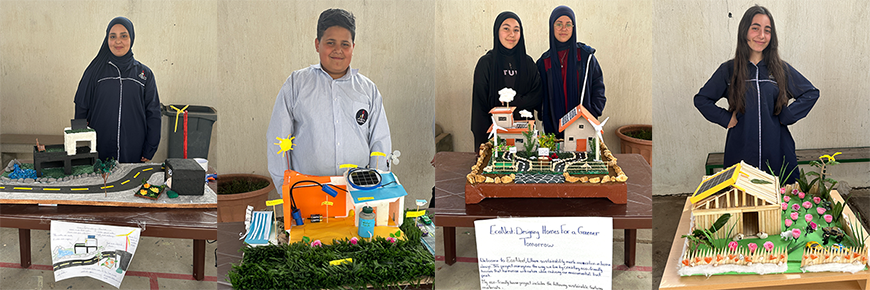
Parents began showing up with carpentry skills, wiring experience, and hard-earned construction knowledge. One father, who had lost everything in the conflict, worked alongside his daughter and told me,“She teaches me sustainability, and I teach her structure. We are rebuilding together.”
It became the most profound form of learning I had ever witnessed:
- Parents learning from their children
- Children learning from their parents
- Teachers facilitating instead of directing
- A community rebuilding itself through design
What began as a classroom project evolved into something much larger—a collective act of healing.
We organized an exhibition to showcase the prototypes and the stories behind them. More than 500 people came - families, students from neighboring schools, principals, teachers, community leaders, and residents who'd lost their homes. People were seeing their children transform trauma into innovation.
Parents stood proudly beside their children’s work. Teachers asked how to replicate the model. Community leaders began conversations about real reconstruction.
That exhibition became the turning point—proof that education doesn't have to wait until "things get better." It can be the very thing that makes things better.
Our local innovation became national policy
UNICEF, the Ministry of Education, and the European Union didn't see this as just another classroom project—they saw proof of concept for crisis education.They saw authentic STEAM learning, problem-solving with minimal resources, parent-student collaboration, and a community reclaiming agency through design. Their decision: This model cannot stay in one classroom.
The eco-home pilot became a fully funded STEAM Lab, supported by the European Union, UNICEF, and the Ministry of Education through the Teaching and Learning Innovation Fund (TLIF).
I now coordinate this lab, working with a growing group of teachers to design hands-on STEAM experiences focused on climate education, renewable energy, and community-driven solutions in resource-limited schools. Learn more about our TLIF-supported STEAM work here.
This journey led me to a new chapter from the classroom to global advocacy. I was elected to the UNESCO SDG4 Youth and Student Network Executive Committee, representing the Arab region. I now advocate for education access, youth agency, crisis-responsive learning, and a simple truth-system: change starts in classrooms, not just policy meetings.
One lesson guides everything I do: Students don't need to wait years to become leaders. They start leading the moment learning becomes meaningful. Authentic STEAM isn't preparation for leadership. It is leadership.
Reflecting on this work, two lessons have fundamentally shaped how I approach education:
- Growth mindset is lived, not lectured
Students didn't develop resilience through worksheets about perseverance—they built it through prototyping, failing, receiving feedback, and redesigning. Iteration became identity. - Community is curriculum
Parents brought expertise schools rarely acknowledged. When students learned alongside them, something profound happened—dignity was restored, and knowledge became intergenerational.
These lessons now guide everything I do: trust students with authentic challenges, embrace constraints as creative fuel, and make learning visible to those who can amplify it.
A question for all of us
What would happen if every classroom became a space where students solve real problems that matter to them right now? Remember, when we trust students with authentic challenges, they don't just prepare for the future, they create it.