From Innovation to Insight: Exploring teacher development for holistic student growth through the Action Learning Framework in Colombia
Lee esta historia en español
How do we develop teachers who support students holistically? This is one of the key questions we’re exploring across the Teach For All network. We believe that the answer lies in empowering those closest to teaching and teacher development to identify and test evidence-based approaches, generate new insights grounded in their lived experiences, and experiment with innovative teacher development models.
Through a collaboration between Teach For All’s Global Institute for Shaping a Better Future and Enseña por Colombia, we put that belief into practice. With the support of a team from Universidad de Los Andes and financed through a grant from the Jacobs Foundation, we engaged in a participatory research process nested in our Action Learning Framework. This approach supports network partners to design and test new teacher development strategies while pairing implementation with rigorous research to translate evidence into practice—and practice back into evidence. Inspired by insights from the Teaching As Collective Leadership (TACL) framework, Enseña por Colombia designed and tested a holistic student outcomes intervention that strengthened social and emotional skills (SEL) instruction and teacher and teacher coach wellbeing.
Although this participatory research did not yield all the results we were expecting on holistic student growth, the process of evaluation proved very helpful from a program perspective. Research and evaluation is not just about proving success— it is about generating the insights we need to improve the design and implementation of our programs and taking the time and space to pause and reflect on those insights. We are committed to learning from the process, reflecting on outcomes, and applying those lessons to better understand how we develop teachers who support students holistically.
Our Action Learning Framework in practice
Building on the insights from the TACL framework and the needs identified by Enseña por Colombia, we invested a year in designing, implementing, testing and reflecting on a new intervention aimed at supporting holistic student outcomes, which included a new SEL teacher training module with a repository of curated classroom strategies, as well as the strengthening of their teacher and teacher coach wellbeing.
Action Learning Framework
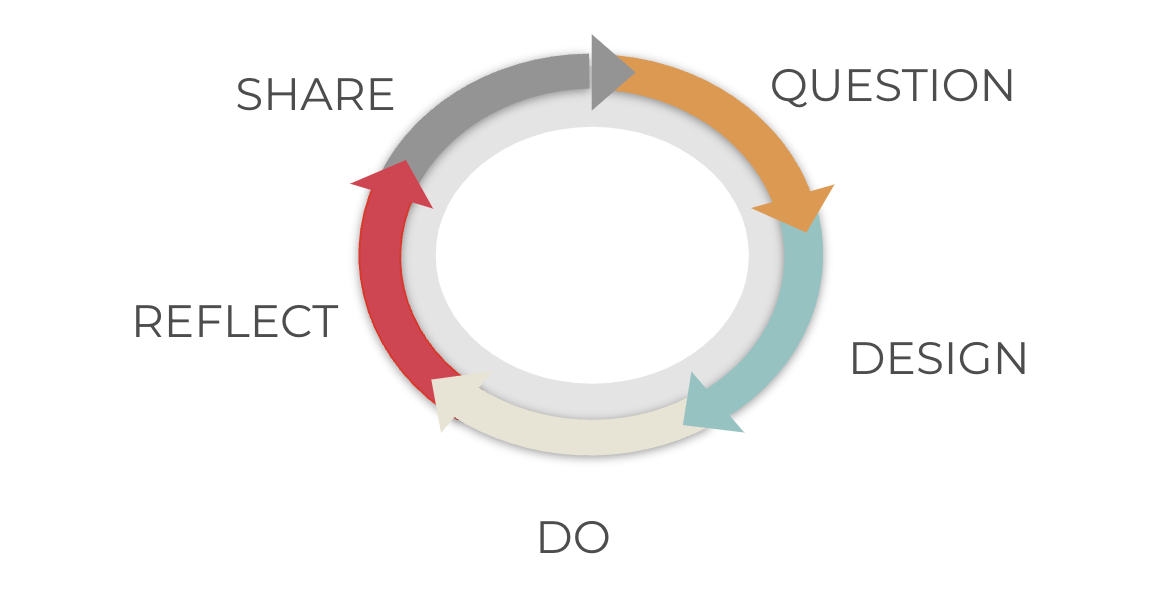 Our collaborative design process included the voices of diverse stakeholders, including teachers, teacher coaches, school representatives, and community members. We piloted the designed innovations with a small group of teachers, and observed a gradual implementation of SEL strategies and an increase in the use of SEL-related language by teachers and students, promoting their understanding and daily practice. One of the key lessons from this process was the importance of prioritizing hands-on practice with SEL-focused classroom strategies during training. This insight informed how we implemented the module at scale during the 2024 school year.
Iterative learning through action research
In the second year of our research, we rigorously studied the impact of these innovations through a randomized control trial (RCT) across 46 schools. While we had hoped to see clear gains in students’ SEL and academic outcomes, overall quantitative results showed similar outcomes between students whose teachers were part of the innovation and those who were not. However, we observed positive impacts in specific SEL domains among students in grades 6 to 9—particularly self-leadership and relationship skills. Qualitative feedback highlighted improvements in student perseverance, motivation, collaboration, empathy, and communication. Teachers also reported gains in leadership skills, greater use of strategies like collaboration and lesson planning, and stronger, more respectful teacher-student relationships.
As part of this effort, we also conducted a program-wide evaluation of Enseña por Colombia using a matching difference-in-difference strategy with 27 control schools. While overall we found that students with an Enseña por Colombia teacher performed on par with other students, we saw notable gains in primary-level reading and math (especially among girls) and improvements in self-leadership in grades 10 and 11. We also found that classrooms led by an Enseña por Colombia teacher were more inclusive and respectful, with students listening more to one another. Enseña por Colombia teachers were also more likely to use TACL-aligned practices, including strong relationship-building, classroom climate, student communication, and lesson planning.
Laying the groundwork for the future
Although our innovation did not achieve all the outcomes we hoped for, it has provided useful learning to strengthen our approach to teacher development in the network. Key learnings include:
- The need for a deep commitment to educational quality and collective leadership from all stakeholders
- The importance of adaptive and reflective practices that allow teams to learn and adjust in real time
- The need to support teachers not only in technical skill-building but also in shaping the beliefs that sustain meaningful change.
What we teach matters, but how we teach—and how we learn together—matters even more.
Looking ahead, we believe that creating clearer pathways for teachers to build their own SEL capabilities, more intentionally link SEL with academic objectives, and ensure that student learning—academic, social, and emotional—remains at the center of the work will help strengthen future program iterations. Building on these insights, Enseña por Colombia is updating their processes from recruitment to alumni engagement and strengthening their selection and training to emphasize both academic excellence and non-academic learning, while deepening the development of leadership mindsets that sustain meaningful change.
Moving forward through collaboration and learning
The implementation of the Action Learning Framework with Enseña por Colombia showed the power of practitioners and researchers working in close collaboration. We want to move forward learning from new collaborations, and commit to sharing openly our findings in order to inform the field of teacher development to support students holistically.
Among Teach For All’s priorities are investing in new ways of supporting partners to better measure student holistic outcomes; learning from teacher development organizations that already are having transformational impact on students to understand how they are training and coaching their teachers; and continuing to partner with organizations like Enseña por Colombia and local researchers like Universidad de Los Andes to engage in participatory research to answer key questions about how to develop students holistically.
We invite organizations and institutions outside of our network that are interested in pursuing a similar journey to connect with us. Getting started with action learning can be simple: listen closely to what both the data and people are saying, stay open to iteration, and take small steps like piloting one innovation, collecting informal feedback, or creating regular spaces for reflection. These small actions help build a culture that values learning and adaptation over perfection. With time, you can grow this into something bigger. What matters most is a shared commitment to learning, reflection, and adaptation.
To learn more about how to get involved, visit the Global Institute for Shaping a Better Future.
For more details about the study, read the research brief (English) and technical report (Spanish).