We are the system: Why the future of education must be created with youth
In our world of continuous change—where political, economic, and climate crises come and go before we can begin to understand them, where every new solution brings new challenges—we, a student and an educator, understand that the role of young people can’t be limited to striving to succeed in existing education systems. Rather, students should be leaders of our shared effort to transform education worldwide—so that a new generation of young people learns to shape a better future for themselves and all of us.
Every child has immense potential that today’s systems of education often fail to nurture. Yet efforts to solve these deep-seated challenges with a single policy or framework have not worked. True transformation will happen only through genuine partnership between youth and adults—a partnership that honors the inherent agency and ability young people already hold. Transforming education isn’t a task for traditional leadership; it is collective work that requires everyone whose role impacts children to work together.
In this effort, student “voice” is important but insufficient. All too often it’s a cover for tokenism. The adults in the room ask for youth "voice," but keep the decision-making power. But it doesn’t have to be this way. Genuine partnership means redistributing power and involving students from the very first idea to the final evaluation. Not as guests in adult spaces, but as co-architects of shared spaces. Students don't just want a seat at the table; they want to help build the table.
In education, that means working with students to program and lead our major events, as they do at the IB’s Festival of Hope. It looks like enabling students to inform the UN agenda, as they are doing through ReModel UN. And it means creating platforms for them to organize and lead change in their communities and countries, as they do through Enseña Perú’s Programa de Liderazgo Estudiantes. Students, with their powerful voices and lived experiences, are ideally placed to bridge the gap between policy and reality, reframing their role from consultants to true co-creators.
Evolution has made young people our ideal partners in this effort. The teenage brain is biologically wired to rethink the world. As neuroscience has proven, adolescence represents a unique period in our development during which the brain reinvents itself in relation to others. In our teens, we are more sensitive to social issues and injustice than at any other point in our lives. This isn't a deficit—it’s a biological disposition to challenging the status quo. Yet while teenagers’ brains are raring to reinvent systems, they’re routinely put in classrooms that see this as a "behavioral issue" rather than an evolutionary superpower.
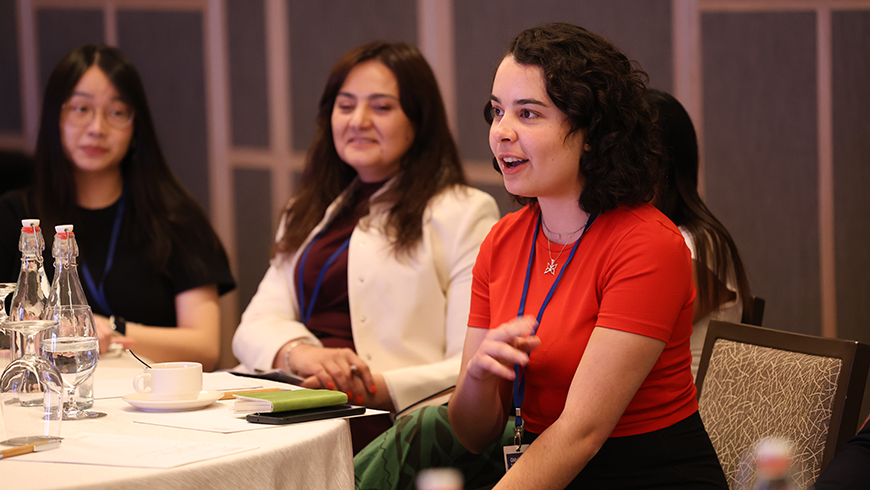
At a recent global roundtable convened by Teach For All’s Global Institute with students, educators, and system leaders from 10+ countries, we asked ourselves what the system of the future should look like, and what role students should play in getting us there. This shift in perspective from giving voice to sharing power led to deep, often uncomfortable conversations. And the students asked us to confront a reality about the very foundation of the systems we are trying to transform: Education is not broken—it is working exactly as it was designed.
Students today know that they are victims of a system designed to sort, rank, and compare young people. A system that rewards individualist competition and develops skills for the industrial workforce of the past. A system that prepares students for a world that no longer exists, and does so perfectly, even when it erodes their wellbeing, agency, and sense of purpose. Instead they dream of a system where young people are both learners and leaders, a system that is rooted not in individualism, but in the development of collective agency and wellbeing. It is time to stop trying to fix the old paradigm and start building a new one.
We often talk about "The System" as a distant, faceless monster. But our participants were clear: "The System" is us. Whether you are a student, a teacher, a school leader, a policymaker, or a parent, your everyday actions in planning lessons, commissioning research, giving funds, or implementing policies are what shapes education as it stands today.
On UNESCO’s International Day of Education, as the world reflects on the power of youth, we offer this challenge, whatever your role: Embrace the deep work of building relationships across generations, giving true power to young people, and acting collectively as a means to transforming our world. Determining the future of education doesn't mean following an existing map; it's an ongoing practice we must engage in together—youth and adults, at all levels of the system.
Young people are already shaping the world. From Nepal and Bangladesh to Togo, Iran, and the UK, young people are already reclaiming their futures. They are organizing mutual aid networks, ousting national leaders, and setting up complex voting systems on Discord before the adults can even settle on an agenda for a weekly meeting. The question is: Will we meet them there, or continue to hold them back?