Raising our voices for climate education at COP30
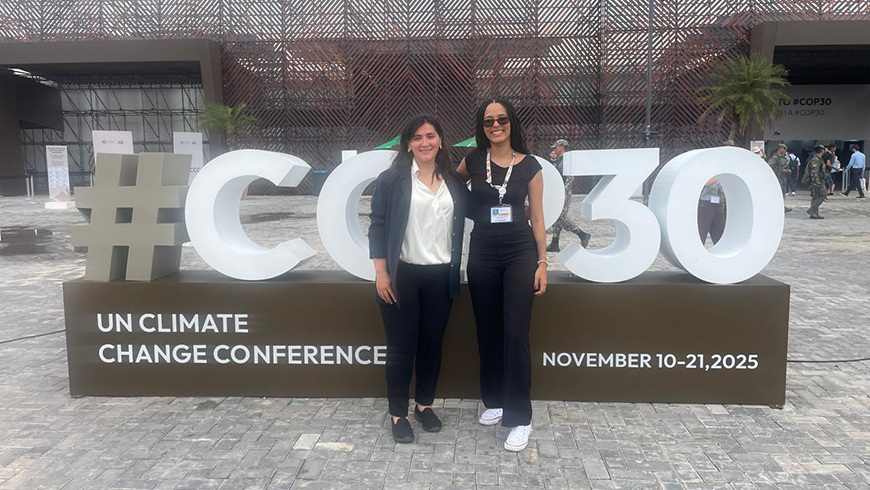
Gabriela Fernández Campos is an Enseña Chile alumna and climate education leader. She wrote this piece with inputs from Marina Castro (Ensina Brasil alumna) who attended COP30 alongside her and several other network alumni.
I never imagined that a conversation at the Teach For All Climate Education Action Summit in Bolivia would lead to a trip to COP30. At the Summit, I was able to hear firsthand from people leading climate education initiatives across the ten represented Latin American countries. I learned about their experiences, sense of purpose, and actions regarding work with students, teachers, and diverse communities for climate action and resilience — from the Chaco Forest in Argentina to the Sierra Nevada in Colombia.
Before arriving in Bolivia, I had participated in the Climate Education Champions Learning Series. This experience strengthened my leadership and motivated me to create a foundation together with two Enseña Chile alumni — Fundación Aprende Verde. I also facilitated a climate education workshop from a systemic perspective for Enseña Chile alumni and fellows and volunteered at an intercultural Indigenous school in the Alto Biobío territory facilitating school garden and recycling workshops.
Through these interactions in Bolivia, I understood even more deeply that strengthening climate education and leadership in our region requires cross-country learning and collaboration. Only then will we be able to create a meaningful impact on our students, educational communities, and territories. The necessity of acting together became undeniable — while the commitment of everyone at the summit made it clear to me that a way forward together was possible.
This motivated me to take my climate education work beyond borders. I have facilitated teacher training workshops on climate education for fellows, alumni, and staff from Enseña por Bolivia, Enseña por Paraguay, and Enseña Perú. I have also shared my experience and journey in climate education with Enseña por México, Enseña por Colombia, and most recently Ensina Brasil.
The climate education and leadership program led by Ensina Brasil and the work they do — just like all the organizations present — struck me as truly powerful. They shared their strategy for engaging at COP30, recognizing that climate education must be a priority in international decision-making processes while these need to be informed by the realities and insights from communities. They launched their ClimaLab initiative to share insights from climate education leadership and inspire more such.
My surprise came a few days later, once I was back in Chile, when Ensina Brasil wrote to invite me to join their delegation at COP30 in Belém, Brazil. I received the invitation with gratitude, but also with the challenge of living up to it: if they were inviting me, it was because my presence could contribute — I felt proud but also daunted by how much I still had to learn in order to adequately represent those who work every day to advance climate education through their leadership.
I prepared by practicing my Portuguese to support Ensina Brasil in connecting with key actors in Brazil and strengthening their climate education work. It was an intense but deeply enriching preparation process: articles, meetings, and hours spent refining how to clearly convey our collective voice.
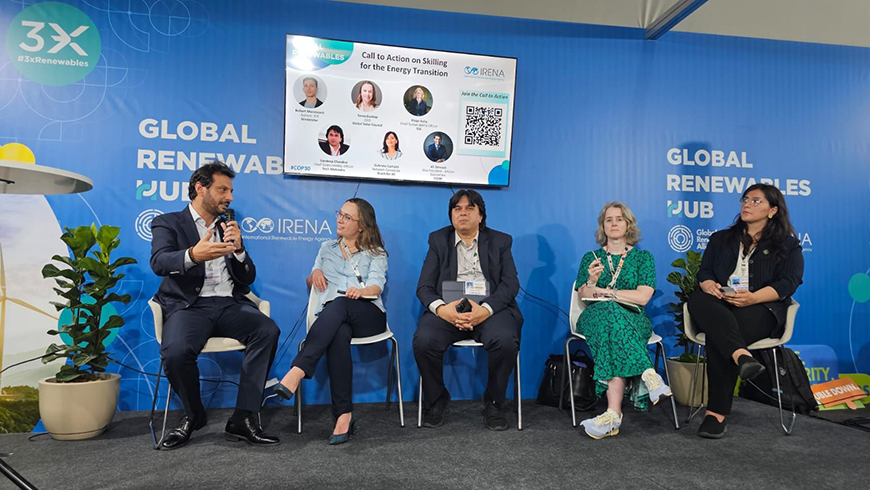
At COP30, every space I participated in reaffirmed the power of education and collective advocacy. I learned about transformative experiences, heard testimonies that still resonate with me, and confirmed that many of us are pushing for real change. I spoke on a panel invited by the International Renewable Energy Agency (IRENA), with the central purpose of positioning climate education as a priority for advancing a more just energy transition. This experience again strengthened my sense of purpose, but also reminded me that there is still so much work ahead — and that if we move forward together, we can go much further.
Holding the COP in the Amazon region brought unique power to the discussions, centering the importance of forests, the voices of indigenous peoples, and the urgency of direct investments in the region. I closely followed how the "COP30 roadmap" mobilized crucial debates on the energy transition, and although final agreements on phasing out fossil fuels did not advance fast enough, the pressure for change was undeniable. What touched me most, however, was witnessing the vibrant grassroots mobilization in Brazil. Institutions, collectives, and NGOs occupied spaces, making the climate debate accessible and connecting diplomacy to people's reality.
At the COP30 venue, climate education was woven throughout various pavilions, but it truly came alive through the largest participation of children and youth in the history of these conferences. It is clear that children are among the groups most vulnerable to the impacts of global warming; their presence in high-level debates is imperative. More than just transmitting data, we need to consolidate climate education as an essential pillar of cultural transition, capable of reshaping our perception and our relationship of care for the planet.
Witnessing this level of engagement reinforced my conviction that, while grassroots mobilization is vital, it must be sustained by foundational knowledge. The energy and desire for change present in Belém need to be channeled through robust educational frameworks. We cannot expect a truly just transition without preparing society to fully understand the complex challenges we face. Climate education acts as the necessary bridge between immediate activism and long-term, informed societal transformation. As one step towards this, I was excited to attend the launch of the OECD’s PISA 2029 Climate Literacy Framework, which will inform the new PISA metric for assessing student knowledge and skills around climate literacy.
The post-COP30 period leaves all of us with a clear challenge — we still have a long way to go so that education is not seen merely as a peripheral topic, but as a strategic and central tool in combating the climate crisis. For example, Ensina Brasil’s Climalab work is rooted in the conviction that it’s really important to strengthen their networks and enhance their collaborative work in different aspects of the education system. I am convinced that it is urgent and important to continue strengthening our collaborations among the different actors working in climate education at the regional level in Latin America, and across all areas of the system — teacher training, school leadership, education policy — and that every actor is capable of driving sustainable and lasting change in our region. This is something that all of us, from our own roles, must take responsibility for. It is possible! The work continues, now with the mission of transforming this Amazonian experience into systemic action.